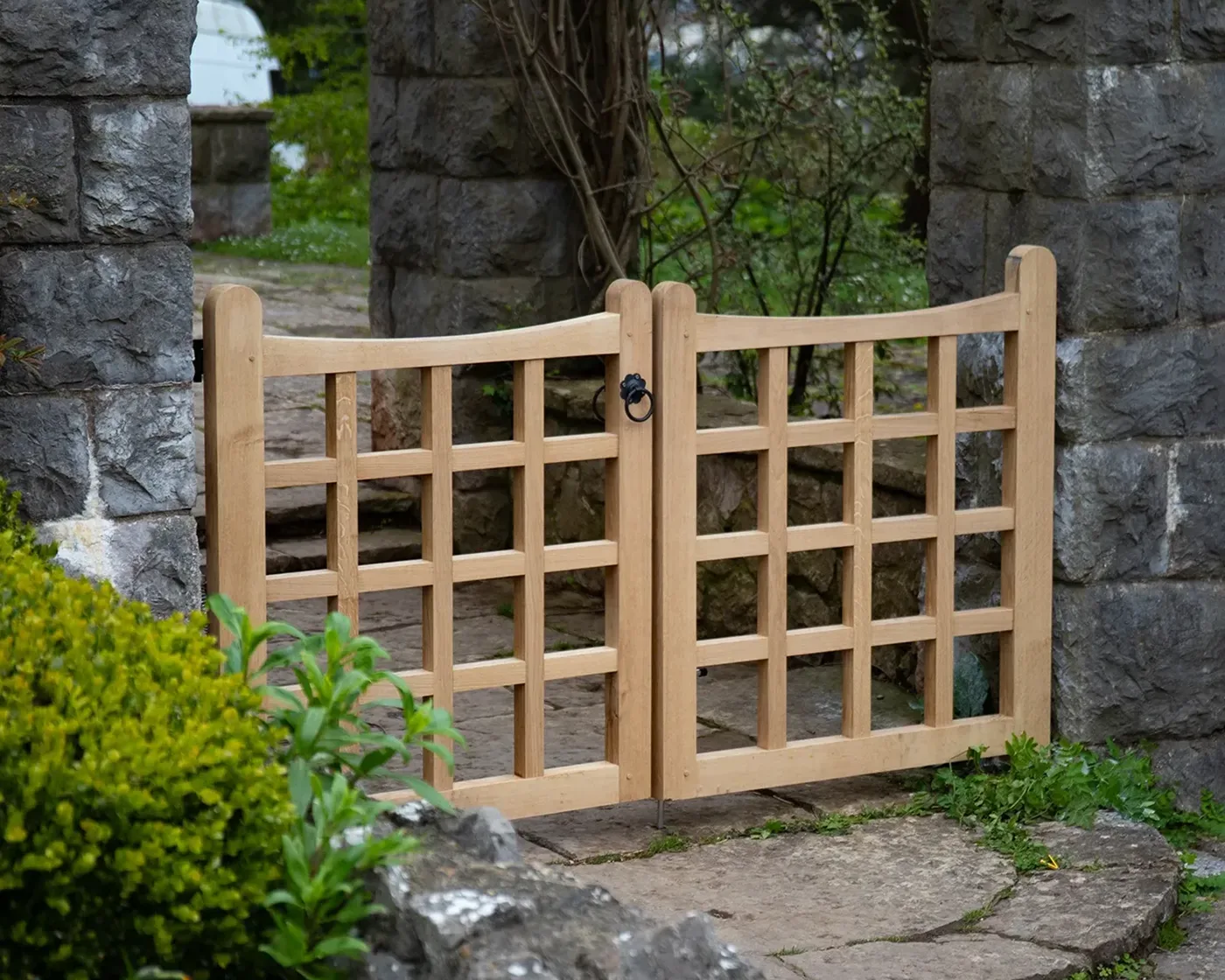
In spring 2024, I worked alongside Josey Garbutt and Krav Metcalfe — the three of us then working together as Foris Studio — on a commission for the Friends of Homeyards Botanical Gardens in Shaldon, Devon. The gardens' entrance gates, which had stood for decades, had deteriorated beyond repair, and the brief was precise: replicate the original gates exactly, using traditional joinery throughout. No creative latitude, which is its own kind of discipline.
The Gardens
Homeyards Botanical Gardens sits on the hillside above Shaldon, looking out over the Teign Estuary. They were designed in the 1920s by the Italian designer Giacomo Bosio and commissioned by Maria Kempe Homeyard, who had built a castle nearby and wanted gardens to match. The combination of formal terracing, rockeries, a lily pond, and a castle-style folly on a steeply sloping south-facing coastal site is particular and worth the climb.
The gates date from the original construction. After a century of coastal air and salt wind, they were beyond reasonable repair, and the Friends of the Gardens wanted new ones that matched exactly rather than approximately.
The Work
We used English air-dried oak throughout, which was both historically appropriate and practically sensible. Air-dried oak retains more of the cellular structure that allows it to weather well in exposed conditions, and it behaves more predictably in the long term than kiln-dried timber in a coastal setting.
The joinery was pegged mortice-and-tenon throughout, which is what the originals had used. Drawbored pegs — driven through offset holes so that tightening the peg draws the joint closed — are what make this kind of construction repairable across decades. It is considerably older than any furniture style and likely to outlast most of them.
The challenge in replication work is in the details the original makers resolved without leaving a record: why a particular dimension is what it is, what a slight irregularity means. You work it out from the evidence in the piece, which is slow but reliable.
During the installation we met the man who had remade the gates in the late 1960s, also as a replication of the 1920s originals. He had been a joiner's apprentice at the time. He told us a bit about making them, and we compared notes on the same joints and the same timber. He seemed pleased they had lasted as long as they had.
See more of the finished piece in the portfolio.