"How much does bespoke furniture cost" doesn't have a single honest answer, and anyone who gives you one number before understanding the brief is guessing. What follows is how a commission actually gets quoted, what moves the price up or down, and how long it takes.
What Actually Drives the Price
Three things do most of the work: scale, complexity, and specification. A single side table asks far less of a workshop than a fitted library built around an irregular room, and the difference in cost tracks that difference in scope directly, not proportionally. Joinery complexity matters within that too: a straightforward mortice-and-tenon frame costs less to build than a piece with curved laminated legs or steam-bent forms, simply because it takes more time at the bench. Specification is the third lever, and it's the one people underestimate: conservation-grade requirements, like the pH-neutral linings and inert surfaces built into a rare-book cabinet for Linacre College, Oxford, add real cost that has nothing to do with size, because the materials and finishing steps are entirely different from an ordinary piece. Personalisation, an inlay, an engraved date, is comparatively minor and usually a fixed addition rather than something that reshapes the whole quote.
Why the First Conversation Is About Budget, Not Just the Brief
Most of these variables can move independently of each other, which is why a single commission can usually be specified two or three different ways once the brief is understood: a different timber, a simpler joint, a smaller footprint, each shifting the price without changing what the piece fundamentally is. Raising budget early, before any drawing is done, means that conversation happens while it's still cheap to have: adjusting a specification on paper costs nothing, adjusting it after a piece is half-built costs a great deal.
What to Bring to a First Conversation
A commission moves faster when a few things are already clear: roughly what the piece needs to do, where it will live (a fitted piece has to work with a specific room, a freestanding one doesn't), and any hard constraints like a listed building, an existing collection it needs to sit alongside, or a deadline it needs to meet. None of this needs to be precise. It's the starting point for a conversation, not a spec sheet.
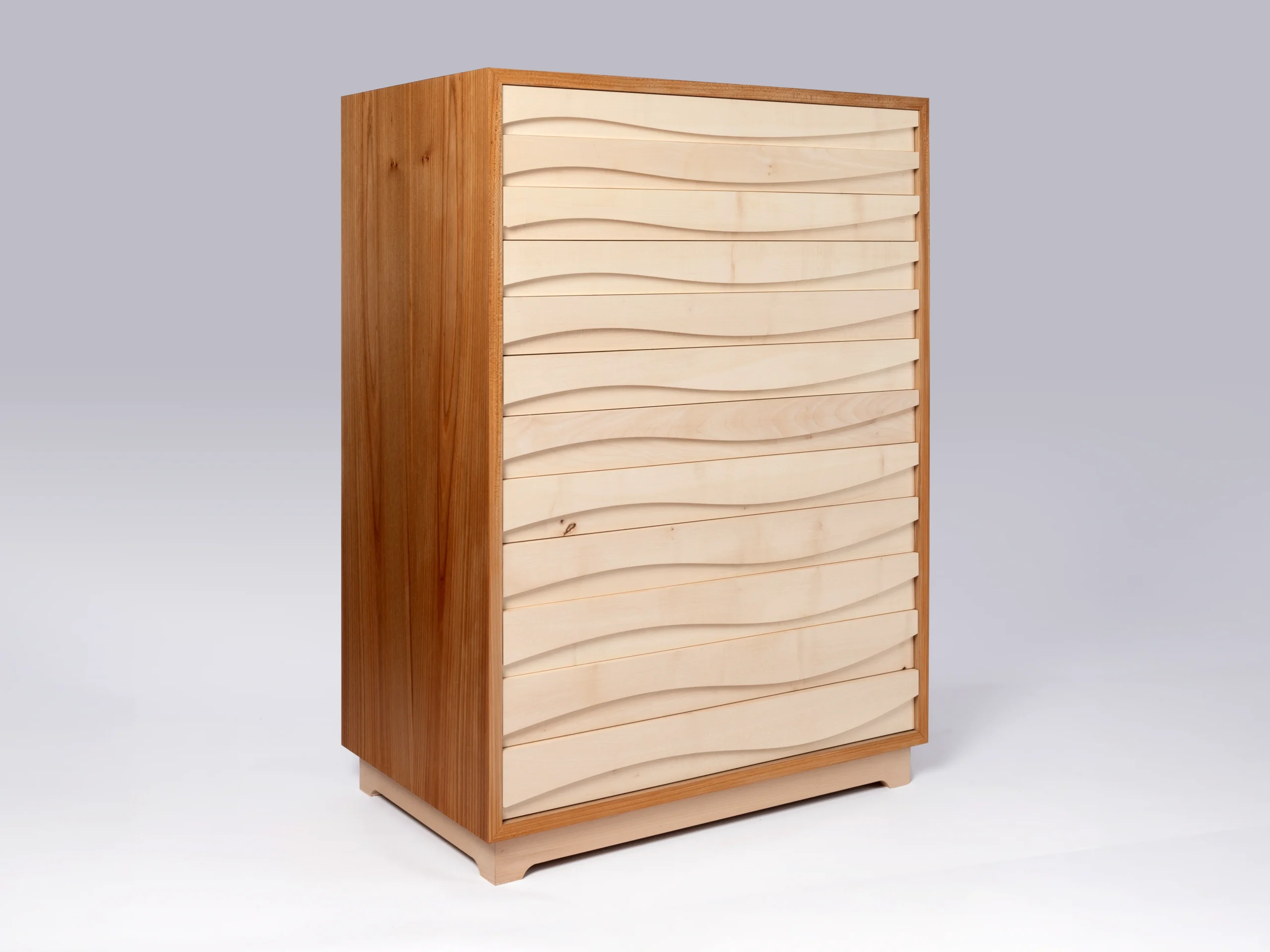
The Process and the Timeline
A bespoke commission starts with a conversation, either at the workshop in Oxfordshire or on site, followed by draft designs adjusted against feedback before anything is costed properly. The quote is confirmed before work begins. From a confirmed brief, a bespoke commission typically takes eight to twelve weeks, longer for large fitted work spanning a full room.
Laura Unwin, Linacre College, University of Oxford, on commissioning a rare-book cabinet for the college library: "He came to visit us on site and we discussed the project. He then produced draft designs, which we adjusted with his guidance to meet our exact requirements."
If you have a piece in mind, get in touch and we'll talk through what it would actually take.