"Because I know that time is always time
And place is always and only place
And what is actual is actual only for one time
And only for one place"T. S. Eliot, Ash Wednesday
When we try to chart where ideas come from, particularly in design, there's a temptation to keep things local. We conclude that styles emerged because a certain set of thoughts happened to coalesce at a certain time in a certain place.
The reality is messier. History isn't linear, and design even less so. Perhaps the frame in which we should understand furniture history is distance itself. We've been global for a long time now.
This text presents three historical moments where distance shaped design. The circumstances for styles to emerge are complex, often connected to events far away. In our current moment, as supply chains buckle and we perhaps enter a new age of localism, this is partly a set of observations on the history of un-localism.
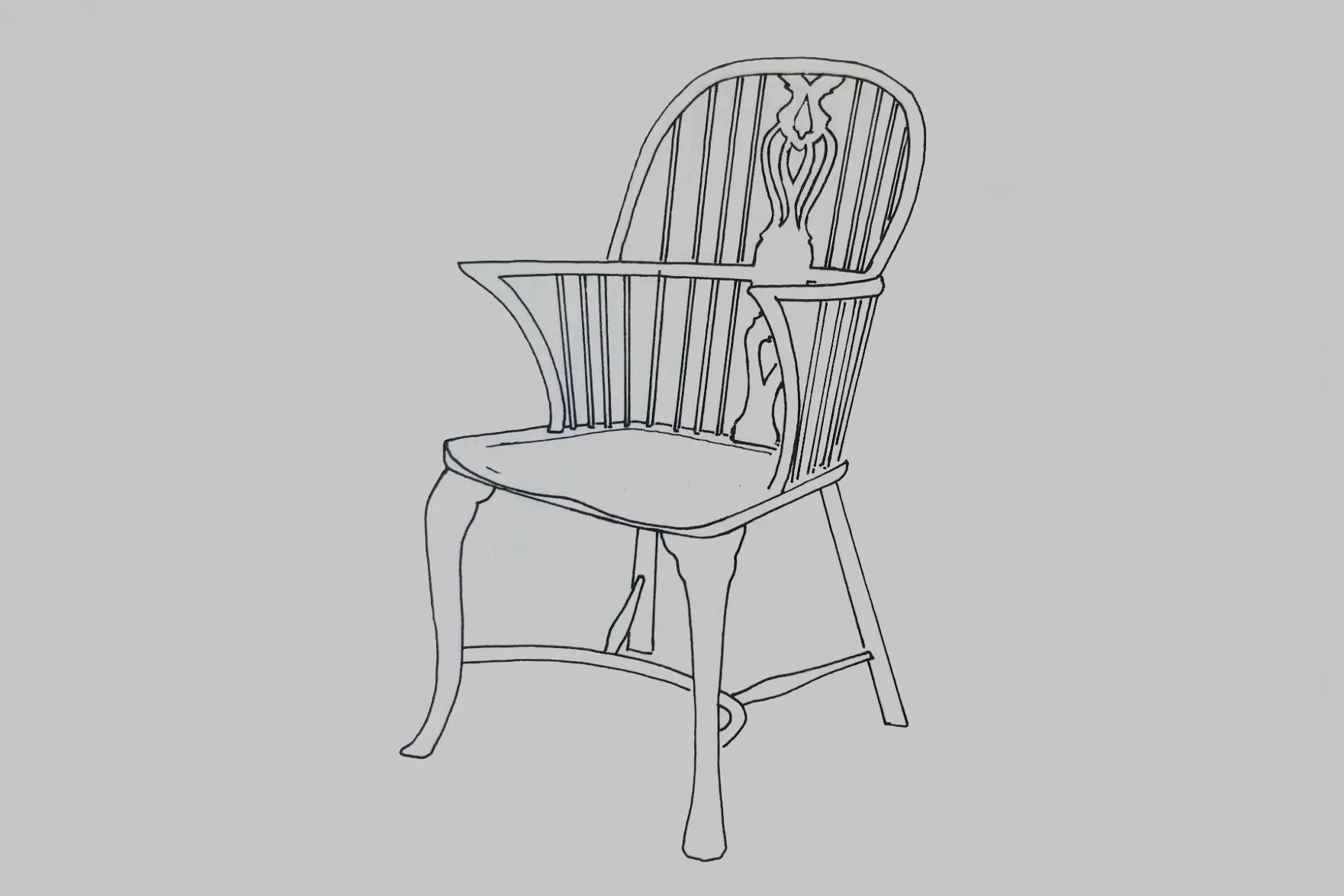
1. The Thames Woodlands & the Windsor Chair
The Thames connects London to the countryside that surrounds it, and also marks the distance between them. The story of the Windsor Chair illustrates this.
There has always been a division between town and country furniture, with town furniture dominating museums and historical collections. The great change came with the restoration of Charles II in 1660. A reaction against Puritan restraint, combined with foreign craftspeople bringing European styles to the court in exile, created an explosion of new furniture. The Great Fire of London in 1666, which destroyed homes and furniture alike, also contributed to a fertile period in the capital.
The exact dates the Windsor chair emerged are uncertain. What seems most likely is that it grew from the "stick chairs" being produced in Wales, first illustrated in the thirteenth-century manuscript of the Laws of Hywel Dda.
The prevailing view is that the chair we know as the Windsor emerged from the beech woods covering the Chilterns in Buckinghamshire. Spindles were turned by bodgers working on rudimentary lathes, eventually making their way along the Thames into high society via the town of Windsor.
But Nancy Goyne Evans, in her meticulously researched essay A History and Background of English Windsor Furniture, suggests the reality is more knotted than this narrative. Her contention is that by the time of the first mentions of the Windsor chair, London was already a well-established centre for turnery, shipping vast quantities of beech from the Chilterns. She quotes Daniel Defoe's A Tour Thro' the Whole Island of Great Britain (1725), describing the area around High Wycombe:
"Here is also brought down a vast Quantity of Beech Wood, which grows of Buckinghamshire more plentifully than in any other Part of England... the Quantity of this, brought from hence, is almost incredible, and yet so is the Country Overgrown with beech in those parts that it is bought very reasonable."
As the first documented references to the Windsor chair occur in 1724 and 1725, this suggests turned chair production from beech may have already been established in the capital. Evans proposes that the waning popularity of the cane chair had created an opening: "members of the turned chairmaker's craft may have recognized the new design that could stimulate the chair market and achieve the same popularity that cane seating had held."
The simple narrative of a perfectly designed country object being adopted by fashionable society is more complicated. There is no single point of origin. The Windsor chair as we recognise it most likely emerged from a mix of different places, skills and market forces.
This hybridisation evolved further in the later 18th century with the appearance of Chippendale Windsors. Following the publication of Thomas Chippendale's catalogue, the Director, in 1754, country chairmakers imitated and simplified the Chippendale style, replacing mahogany with oak but somewhat awkwardly retaining the cabriole legs of fashionable town furniture.
2. The Atlantic: Mahogany and Slavery
A much darker moment of dislocation can be traced through the 18th century and the mahogany furnishings of high society. This is a narrative of environmental and human tragedy that haunts the furniture of this period. It is important not to look past this history, as it is embedded in the material itself.
Charles Dickens and Wilkie Collins observed as much when examining a mahogany desk that had "grown so dark with time that it seems to have got something of a retrospective mirror-quality into itself, and to show the visitor, in the depth of its grain, through all its polish, the hue of the wretched slaves who groaned long ago under old Lancaster merchants."
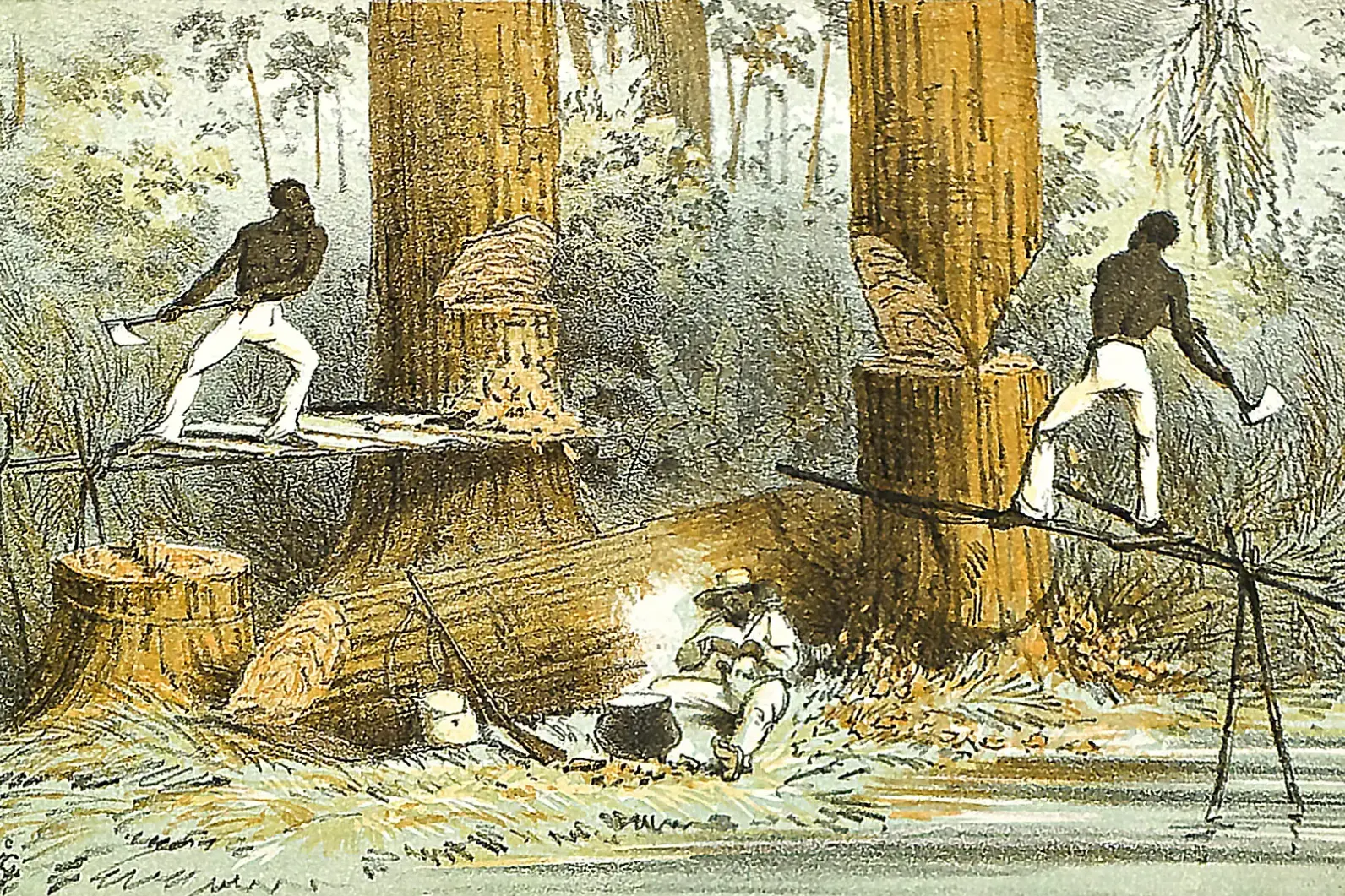
The first mass felling of mahogany happened in the West Indies, where it was cleared to make space for sugar cane plantations. Initially seen as worthless, the mahogany was used as ballast on ships bound for England, eventually dumped in vast quantities on the quaysides of major British ports. By the mid-18th century, the availability of this wood, combined with its exotic origins and material qualities, made it the favoured timber of leading cabinetmakers.
The initial forest clearances of the West Indies were rapid and brutal. Jennifer L. Anderson, in her essay Nature's Currency: The Atlantic Mahogany Trade, writes that an observer "would have seen countryside dominated by fields of sugar cane and dotted with the ragged stumps of mahogany trees, many over nine feet tall. Mahogany once grew so abundant that woodcutters sawed out only the most ornamental part of the tree, leaving the rest to decay."
This environmental catastrophe was enabled by slavery and indentured labour. Slaves branded with owners' monograms lived in thatched huts and scouted for trees. They dragged and rolled felled mahogany trunks to riverfronts, then floated the logs, chained together, to ships waiting in bays full of sharks and coral reefs. These brutal acts laid foundations for the systematic exploitation that would characterise the transatlantic sugar trade.
Mahogany came to define the 18th century school of furniture making, what Percy Macquoid calls "the age of mahogany." The wood has a hard, firm texture which nevertheless carves well, allowing designers to develop a highly refined style that filled the stately homes of Britain and became representative of wealth and taste.
While great craftspeople produced great works with this material, it is vital to bear in mind the circumstances of its arrival on British quaysides. Through the movement of materials, the drawing rooms of 18th-century Britain are directly and physically linked to sites of cruelty both distant and at the heart of the Empire.
3. The Baltic Sea: Plywood and Wartime Europe
This is a story of modernity curtailed.
Britain in the 20th century had an uneasy relationship with modernism, struggling to move beyond Neo-Victorianism. Gerald Summers represents a bright and brief blaze of modernity in 1930s London with his Simple Furniture Company. This is something of a "what if" story: events far away and beyond his control snuffed out his company in under a decade.
Gerald Summers (1899–1967) trained as an engineer. After war service he found himself working at Marconi's Wireless Telegraph Company, where he met Marjorie Butcher (1909–1996). Marjorie wanted new furniture for her flat, and Summers, with his engineering mind engaged, designed and built her a set of painted plywood pieces. This led to marriage, and in 1931, to the founding of The Makers of Simple Furniture.
Meanwhile, in Finland, the architect Alvar Aalto (1898–1976) had married fellow architect Aino Marsio (1894–1949) in 1924. They collaborated closely on designs, though Alvar frequently received credit for work they had done together. By the early 1930s, Aalto was experimenting with bent plywood for the Paimio Sanatorium, producing pieces that would become design classics: the Paimio Chair (1931–32) and the Model 60 Stacking Stool.
Summers' use of bare plywood was unusual in 1930s Britain; some have speculated his limited skills as a furniture maker prevented him from veneering the pieces. By 1933, a steady stream of orders was coming in and they moved to larger premises, hiring their first cabinetmaker. Their efforts were emboldened by access to aircraft plywood, a material easier to manipulate that allowed ever more experimental designs.
In November 1933, Aalto's furniture made its British debut at an exhibition called Wood Only at Fortnum and Mason in London. The bent laminated birch stools caused a sensation.
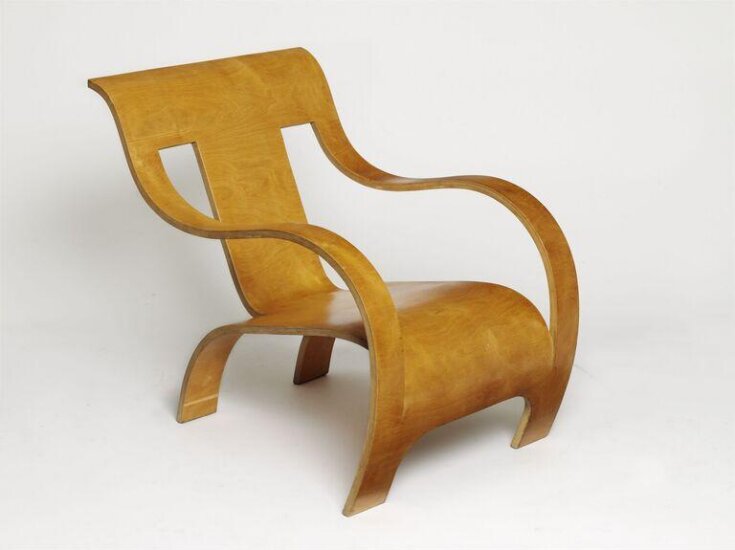
Also exhibiting at Wood Only were Gerald and Marjorie Summers. But The Makers of Simple Furniture had taken a different direction, focused on bespoke work and individual commissions. They remained "a responsive conscientious practice that privileged the client's individual needs and desires." This reliance on patrons gave them flexibility and enabled genuinely radical work throughout the 1930s. Clients such as Dr Eric and Thérèse Megaw supported the production of the Fireside Chair (1933, sometimes called the Megaw Chair), one of the first experiments with aircraft ply to create a sprung back, made almost entirely from a single sheet of plywood.
The Summers' decision to work face to face with customers, rather than scale up to mass manufacture, contained the seeds of their downfall. When World War II broke out, plywood imports from the Baltic states were severely restricted. Their refusal to stockpile materials meant they had to turn down orders. With almost all plywood being imported to Britain needed for aircraft construction, the Summers were unable to source the material central to their entire design philosophy.
They also faced competition from manufacturers like Artek, founded by the Aaltos in 1935 with Maire Gullichsen and Nils-Gustav Hahl, who being closer to the birch forests of the Baltics could secure material more easily. In 1940, after nine years of trading, Makers of Simple Furniture declared bankruptcy.
Design & Dislocation
These three stories, the Windsor Chair, the mahogany trade, and the rise and fall of Gerald Summers' plywood furniture, show that design is not an isolated, local phenomenon. It is shaped by the movement of materials, the migration of people, and the impact of distant events.
The thing that unites these three historical moments is the sense of materials moving: beech along the Thames, mahogany across the Atlantic, plywood over wartime Europe. As we enter a period giving new primacy to environmental concerns in design thinking, we would do well to bear in mind the influence that the movement of materials has had, creatively and inexorably, bound up with the darker side of trade.
Localism offers much, and greater awareness of materials and their sources is a key part of this. Yet as we develop new models of working we must not lose sight of the fact that ideas do not emerge in a vacuum. The complex networks of trade and movement of materials have been embedded in design since the construction of neolithic monuments over five thousand years ago. An awareness of this is essential in remaining open to new ways of thinking, whilst working in a world with increasingly finite resources.